Stop 6 of six
A better market does not need a bigger middleman.
It needs better infrastructure. Here is how the mechanism compounds once it is running, where it expands beyond merchant acquiring, and where an infrastructure provider fits without Top of the Book becoming the thing it was built to replace.
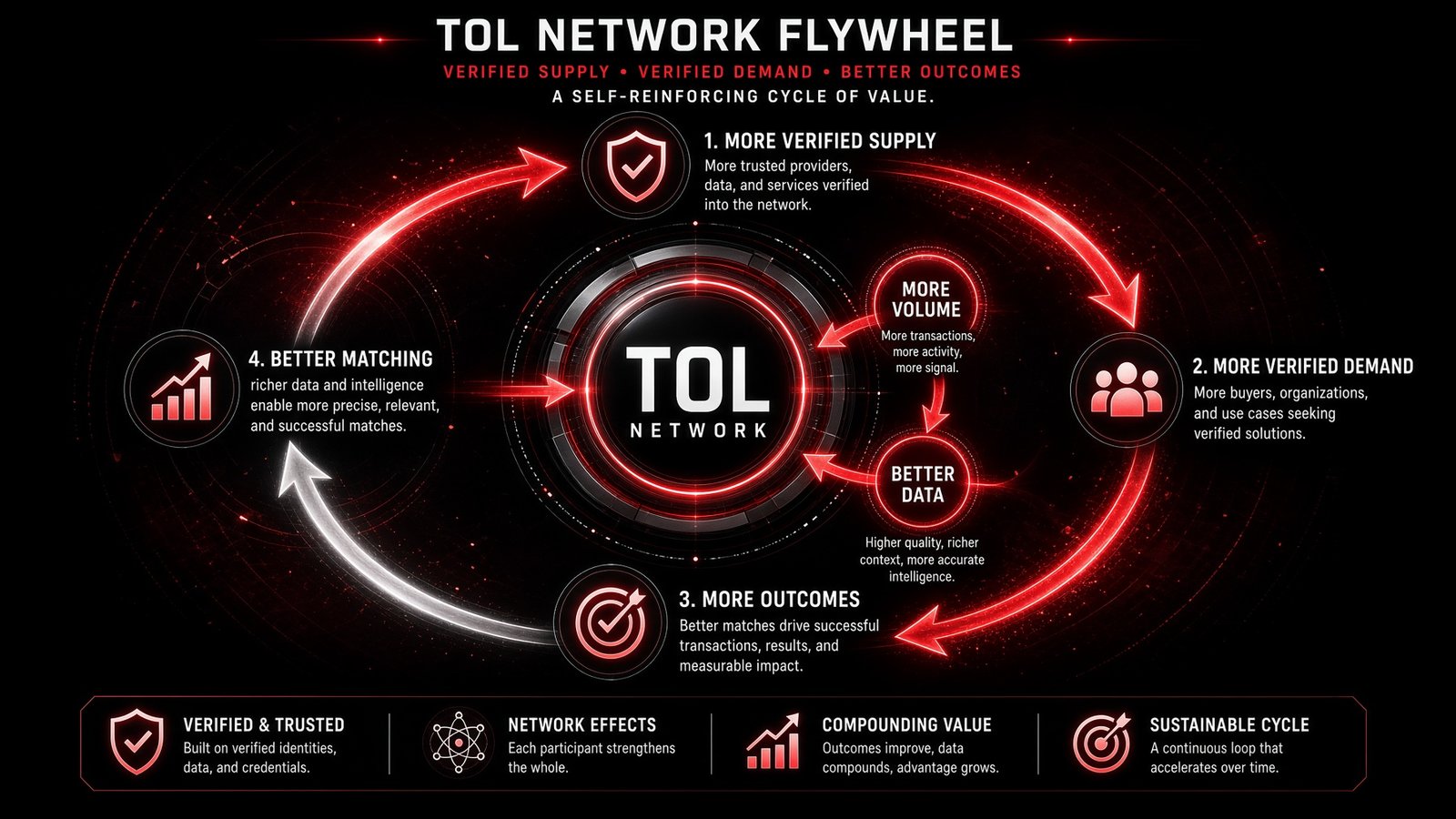
The flywheel
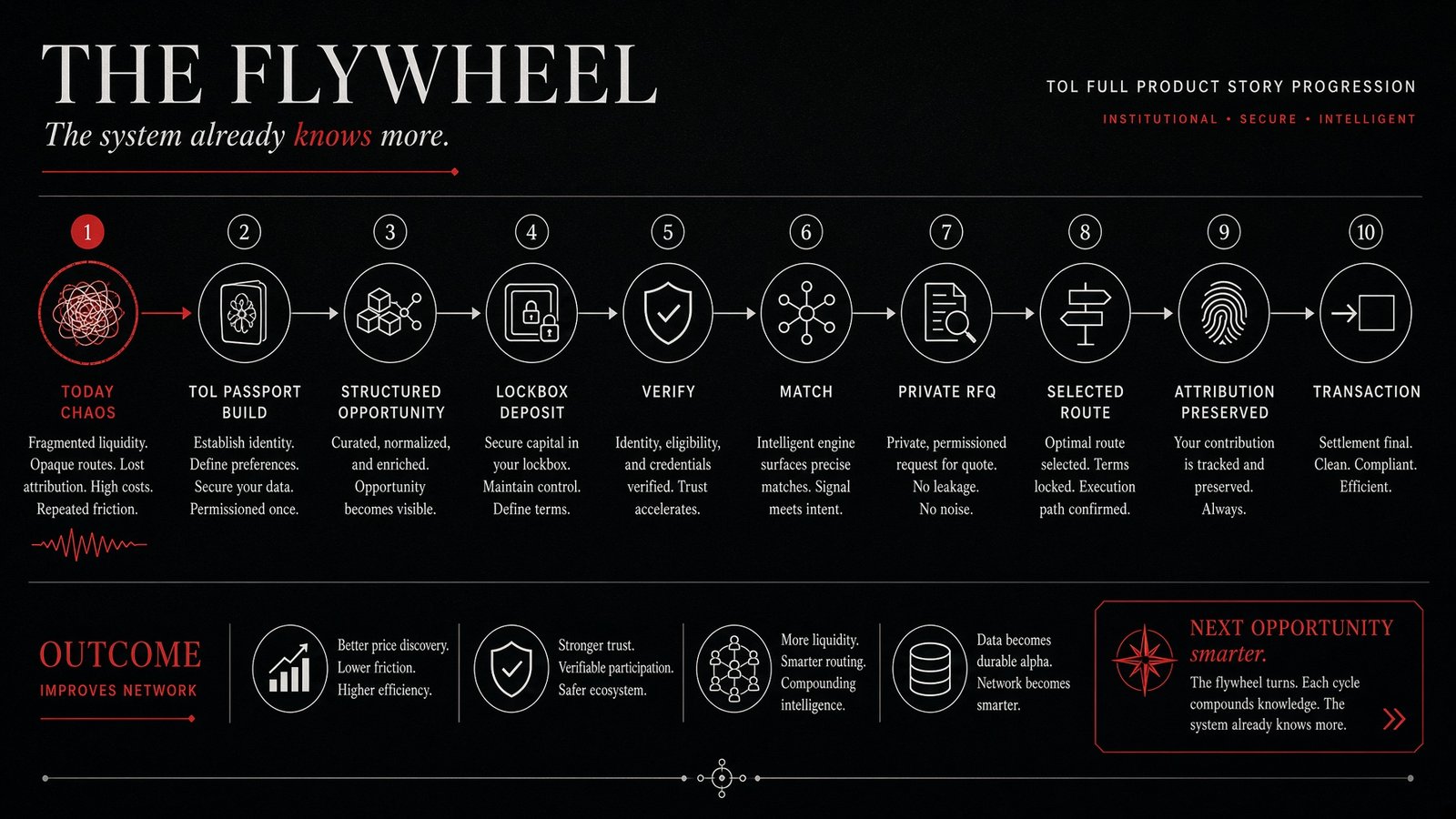
More verified demand attracts more verified acquirers, because there is finally a reason for real capacity to show up rather than sit in someone’s private book. More acquirers mean more matchable capacity. Better capacity means better matches. Better matches produce more outcome data — which routes actually held up after activation, not just which ones looked good on paper. More outcome data earns more trust in the system itself. More trust brings more contributed relationships into the lockbox layer. More sealed relationships mean more liquidity in the market. And more liquidity is what attracts the next wave of verified demand. The cycle repeats, and each turn makes the next one cheaper to run.
More verified supply
More providers seal real capacity into the lockbox layer, because there is now a market that can actually route demand to them.
More verified demand
More qualified opportunities enter through the passport layer, because the market has enough visible capacity to make participating worthwhile.
More outcomes
More matches activate and run their course, producing a growing body of real performance data instead of anecdote.
Better matching
Outcome data feeds back into ranking, so the next match is measurably better informed than the last one — and the cycle turns again.
Beyond merchant acquiring: a marketplace for markets
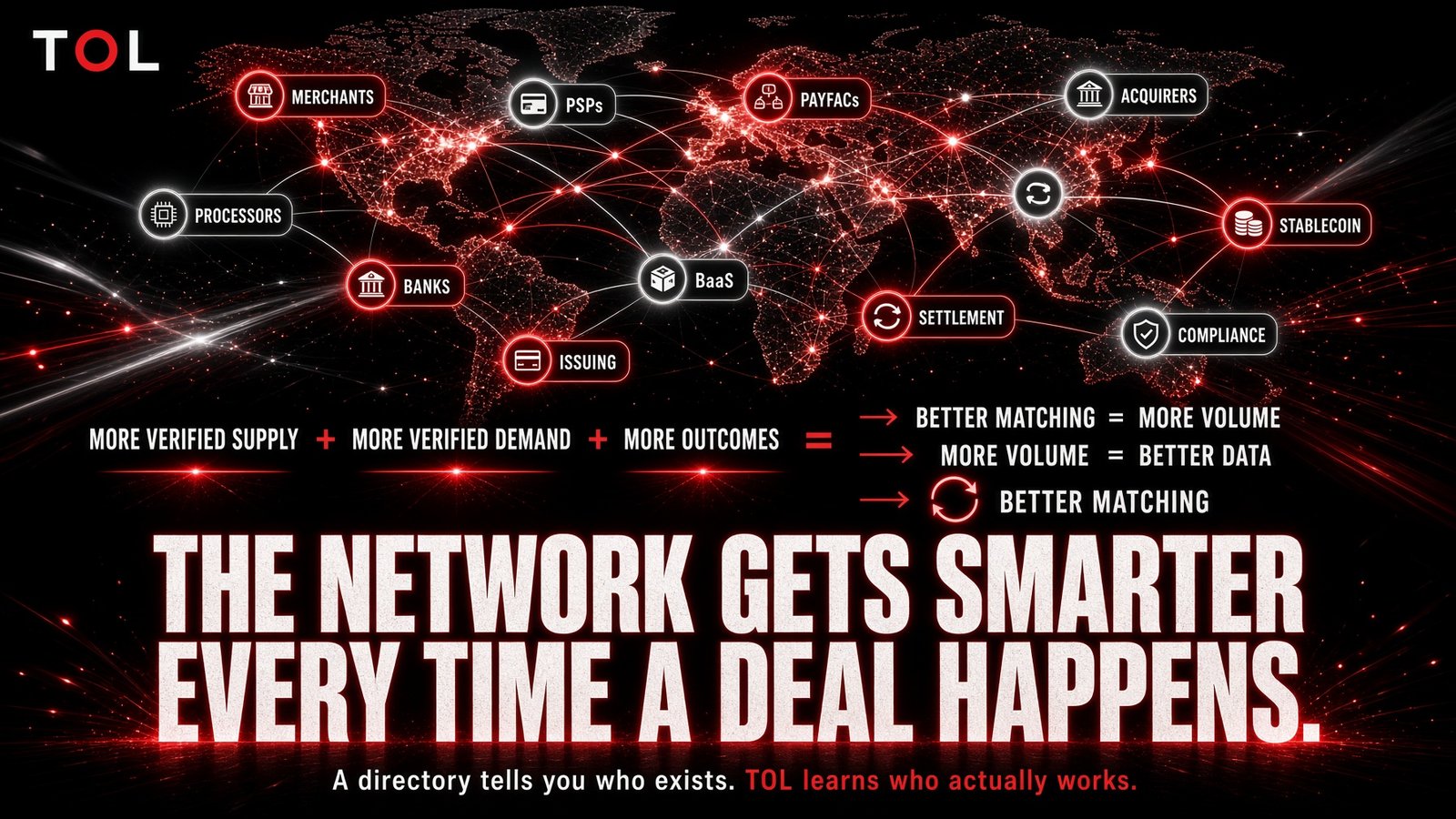
The same four-layer mechanism — passport, lockbox, matching, visible aggregate capacity — does not only work for merchant acquiring. It works for any relationship-driven financial category where trust is currently rebuilt from zero every time.
Phase 1 — Merchant Acquiring
The category this tour has walked through: merchant, PSP, and acquirer relationships, matched on jurisdiction, MCC, volume, risk, and settlement.
Phase 2 — Payments Infrastructure
The adjacent rails: settlement, FX, and the infrastructure providers that sit underneath acquiring rather than beside it.
Phase 3 — Financial Services Marketplace
Banking, BaaS, custody, issuing, and stablecoin relationships — the same passport-and-lockbox mechanism applied to a wider set of institutional counterparties.
Phase 4 — Institutional Trust & Routing Network
KYC/KYB and compliance relationships join the same graph, and Top of the Book becomes less a marketplace for one category and more the routing and trust layer underneath several of them at once.
Where an infrastructure provider fits
A proposition, not an agreement — the paragraph below describes a category of fit, illustrated with one recognizable public example, to make an abstract point concrete. It does not claim any conversation, agreement, or relationship exists.
Digital-asset infrastructure providers — Fireblocks is a clean, public example of the category — are built for a specific stack: keys, custody, chain connectivity, tokenization. Conventional card acquiring is explicitly outside that stack; it is not what the infrastructure is for, and providers in this category say so themselves. When a customer or a prospect shows up needing conventional acquiring capacity anyway, that demand currently has nowhere good to go. It either dies somewhere in a broker chain, or it gets handled ad hoc by whoever happens to know someone.
Top of the Book is a proposition for a cleaner path for exactly that kind of out-of-scope demand: qualify it, give it a passport, match it through the private layer to a real acquiring relationship — and hand back a stronger, better-organized customer than the one who first showed up asking. A customer who now has more of its financial stack running through structured, verified rails is a customer more likely to consume more of the infrastructure provider’s own product next, not less. The infrastructure provider does not have to build acquiring capability, staff it, or hold the risk of getting it wrong. It only has to know where to point demand that was never going to be served by its own stack anyway.
A better market does not need a bigger middleman.
It needs better infrastructure.
That is the whole argument, stop to stop: make relationships visible enough to be a market, private enough to stay worth having, and structured enough that a good deal stops dying three introductions deep in a chain nobody can verify.