Stop 5 of six
Better information. Better matches. More deals get done.
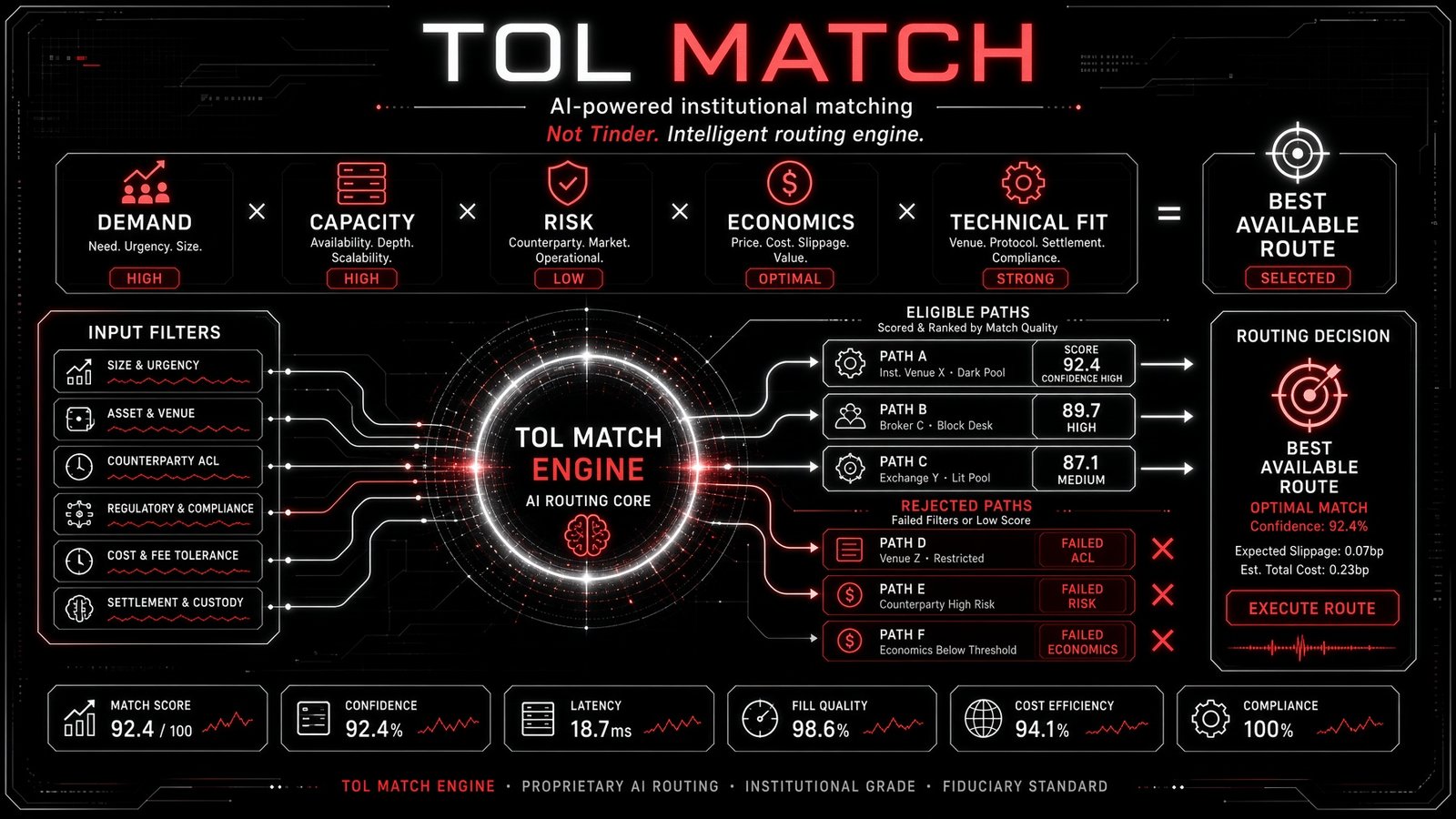
Eligibility first, then ranking among only the routes that actually qualify. The atomic unit of a match is not a name and a handshake — it is a specific set of attributes checked against another specific set of attributes.
The atomic unit of a match
A broker matches on one axis at a time, usually price, usually from memory. Top of the Book matches on all of the axes that actually determine whether a deal clears underwriting, simultaneously, because the passport and the lockbox already hold the data to check them.
- Jurisdiction. Does the counterparty actually write business in this geography, today, not two years ago.
- MCC. Does the acquiring appetite actually cover this category, not a neighboring one that looks similar on paper.
- Volume. Is the claimed GPV inside the range either side can actually handle.
- Risk. Chargeback history, reserve requirements, the shape of the risk both sides are actually accepting.
- Card geography. Where the cards themselves are issued, which determines which acquiring relationships are even relevant.
- Settlement. Currency, rail, and cadence — including whether either side settles in a stablecoin and whether that is acceptable to the other.
- Technical fit. Integration method, gateway compatibility, whatever makes a theoretically eligible route practically workable.
- Economics. Rate, reserve, and margin, checked last — on purpose. See below.
A worked match, demand against supply
Two illustrative profiles, checked attribute by attribute. Neither names a real company.
| Attribute | Demand — PSP A | Supply — Acquirer B | Fit |
|---|---|---|---|
| Jurisdiction | Turkey | Turkey — eligible | Match |
| MCC | High-risk category, card-not-present | Category appetite confirmed | Match |
| Volume | $8M movable GPV | $20M capacity | Within range |
| Risk | 0.30% chargebacks | 8% rolling reserve required | Acceptable |
| Channel | CNP | CNP supported | Match |
| Settlement | USDT preferred | USDT accepted | Match |
PSP A — Turkey, high-risk MCC, $8M movable GPV, CNP, 0.30% chargebacks, USDT settlement. Acquirer B — Turkey eligible, $20M capacity, 8% rolling reserve. Illustrative, both sides fictional.
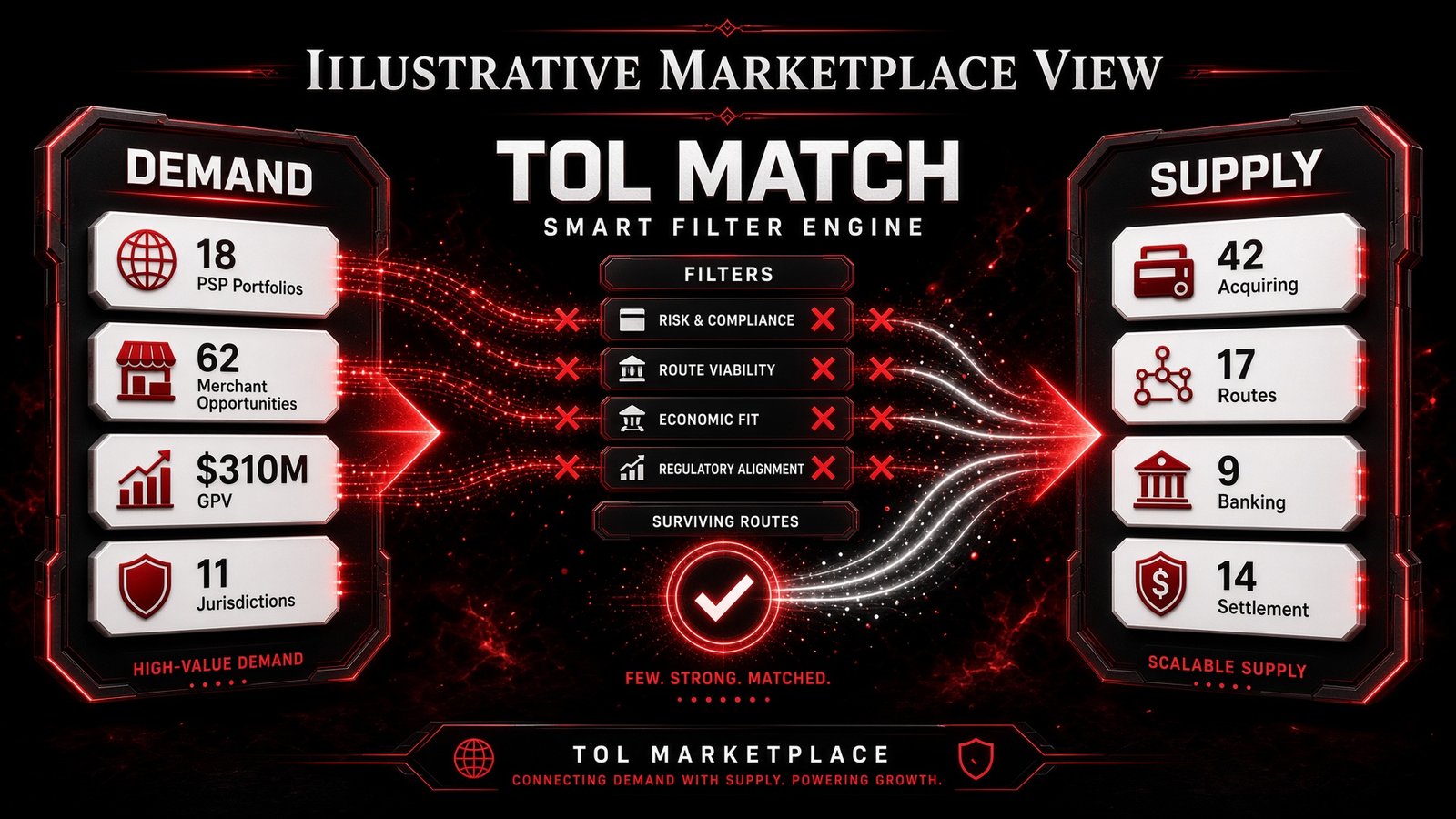
Eligibility first. Ranking second.
A route that fails eligibility never reaches ranking, no matter how good its economics look.
Eligibility
Every candidate route is checked against the hard constraints — jurisdiction, MCC, licensing — that make a match possible at all. Anything that fails here is out, regardless of price.
Ranking
Only among the routes that cleared eligibility, Top of the Book ranks by the full weighted set — risk, volume fit, technical fit, and economics together, not economics alone.
Private RFQ
The top-ranked routes receive a private request for quote. Neither side is broadcast to the wider market — this is a conversation between two qualified counterparties, not a public auction.
Conditions
Reserve, rate, settlement terms and any remaining conditions get negotiated directly between the two sides, with Top of the Book’s role already done — it found the route, it does not set the price.
Match
Terms agreed, attribution recorded, the lockbox contents release to the extent the deal requires — and no further.
Activation
The relationship goes live between the two counterparties. The outcome data — whether it actually performed as matched — feeds back into the system for the next match.
The best route is not the cheapest route
A broker chasing a single deal is incentivized to maximize what that one deal pays. Top of the Book is built around a different arithmetic: humble margins, applied across a much higher conversion rate, across many more transactions, at scale, beat squeezing the maximum out of any single deal.
The best route is not the cheapest route. It is the one that actually clears, settles, and is still standing after the second and third transaction.
The principle behind the ranking, not just the eligibility check
A route that is 20 basis points cheaper but has a rolling reserve neither side can actually live with is not a better match — it is a deal that dies at activation, or worse, three months in. Ranking on the full attribute set instead of price alone is what keeps matched deals matched.

Every layer up to here exists to make this stop possible.
A passport that can be trusted, a lockbox that protects the relationship behind it, and a market that can see enough to route intelligently — all of it converges on one better match. What happens when this compounds across the whole network is the last stop.