Stop 1 of six
From relationship chaos to market infrastructure.
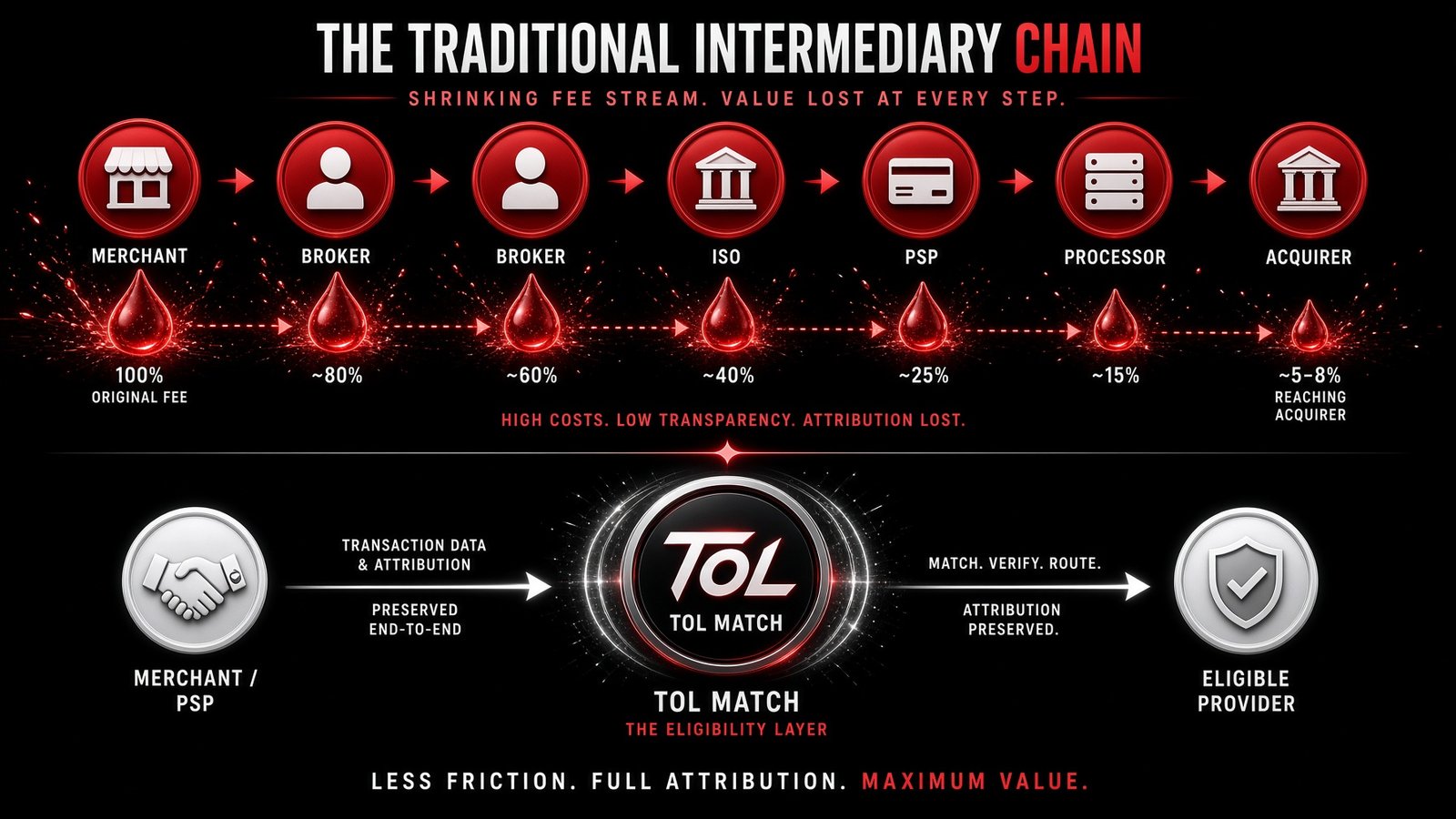
Fragmented merchant acquiring still runs like a private broker market — the cowboy OTC era. Everyone arrives with a nonsense deal, everyone argues over points, and the chain itself is the product. Here is what that actually costs.
The chain everyone already works inside
Strip the language and the shape is familiar to anyone who has tried to place a hard-to-place merchant: a portfolio starts with someone who knows a merchant, and by the time it reaches someone who can actually underwrite it, it has passed through several more people who each know someone else.
Merchant. Broker. Another broker. ISO. PSP. Processor. Acquirer. Each hop exists because the last person in the chain did not have direct access to the next one — not because each hop adds diligence, verification, or anything an acquirer will credit later. Each one also expects to be paid for having been in the room, which is a separate problem from whether the deal is any good.
None of this is a scandal. It is just how a market behaves before it has infrastructure. Real estate ran this way before MLS. Equities ran this way before a consolidated tape. Merchant acquiring is still running this way, and the chain above is the artifact of that — not a conspiracy, a symptom.
Uncertainty at every hop
The chain does not just cost fee stream. It costs certainty, and certainty is what underwriting actually needs.
- Unknown jurisdiction fit. Nobody in the chain can say with confidence which acquirers actually write this merchant’s country and card geography until someone finally asks one directly — often after weeks of introductions.
- Unknown MCC support. High-risk category codes get shopped blind. A broker’s guess about who “probably” takes a given vertical is not the same as a verified appetite.
- Undefined volumes. GPV figures soften and firm up differently at every hop, because everyone in the chain has an incentive to make the deal look bigger to the next person.
- Duplicate introductions. The same merchant reaches the same acquirer through three different chains at once, none of them aware of the others, all three claiming the relationship.
- Unverifiable claims. “I have a direct line to their risk desk” is unfalsifiable until the deal either lands or doesn’t. There is no passport, no history, nothing to check it against.
- Viable deals dying before underwriting. The most expensive failure mode in the category. A merchant with real, fundable volume never reaches a real underwriter, because it ran out of trust three introductions before it got there.

Payments shouldn’t run on “I know a guy”
The industry does not have a lead problem. Introductions are not scarce — anyone who has worked this market for a year has a phone full of them. The industry has a structure problem: no shared way to verify who is real, what they actually have, and whether the last three people already tried the same acquirer with the same merchant last month.
The deal was real. The volume was real. It died anyway — not on the merits, three introductions deep in a chain nobody could verify.
The pattern this tour exists to fix
That is the gap. Not a lack of relationships — an absence of the infrastructure that would let good relationships compound instead of leaking value at every hop.


Structure before introduction
Top of the Book does not try to out-hustle the broker chain, and it is not another directory to add to the pile. It replaces the chain’s job — verification, visibility, and a route to the right counterparty — with infrastructure that does that job the same way every time, for every participant, whether they showed up on day one or joined this morning.
What that infrastructure actually looks like is a closed but visible marketplace, built in four layers. That is the next stop.