
Stop 4 of six
Bring the relationship. Keep the attribution.
A relationship can enter the market sealed — visible to everyone as inventory, private to everyone but its owner in its contents. This is how the market shows depth without asking anyone to publish their book.
Sealed, not hidden
Every relationship worth anything in this market was built by someone, over time, at some cost. The person who spent two years earning an acquirer’s trust has no reason to publish that relationship’s name where a competitor can read it off a screen and go around them. But a market that cannot see any of that inventory cannot function as a market either — it is back to being a rolodex.
The Lockbox is the resolution: a contributor deposits a relationship into a sealed record. The market can see that the record exists, roughly what it covers, and that it has been verified — without ever seeing who the counterparty actually is. The contents unlock only when a real, eligible match is on the table, and only with the contributor’s release.
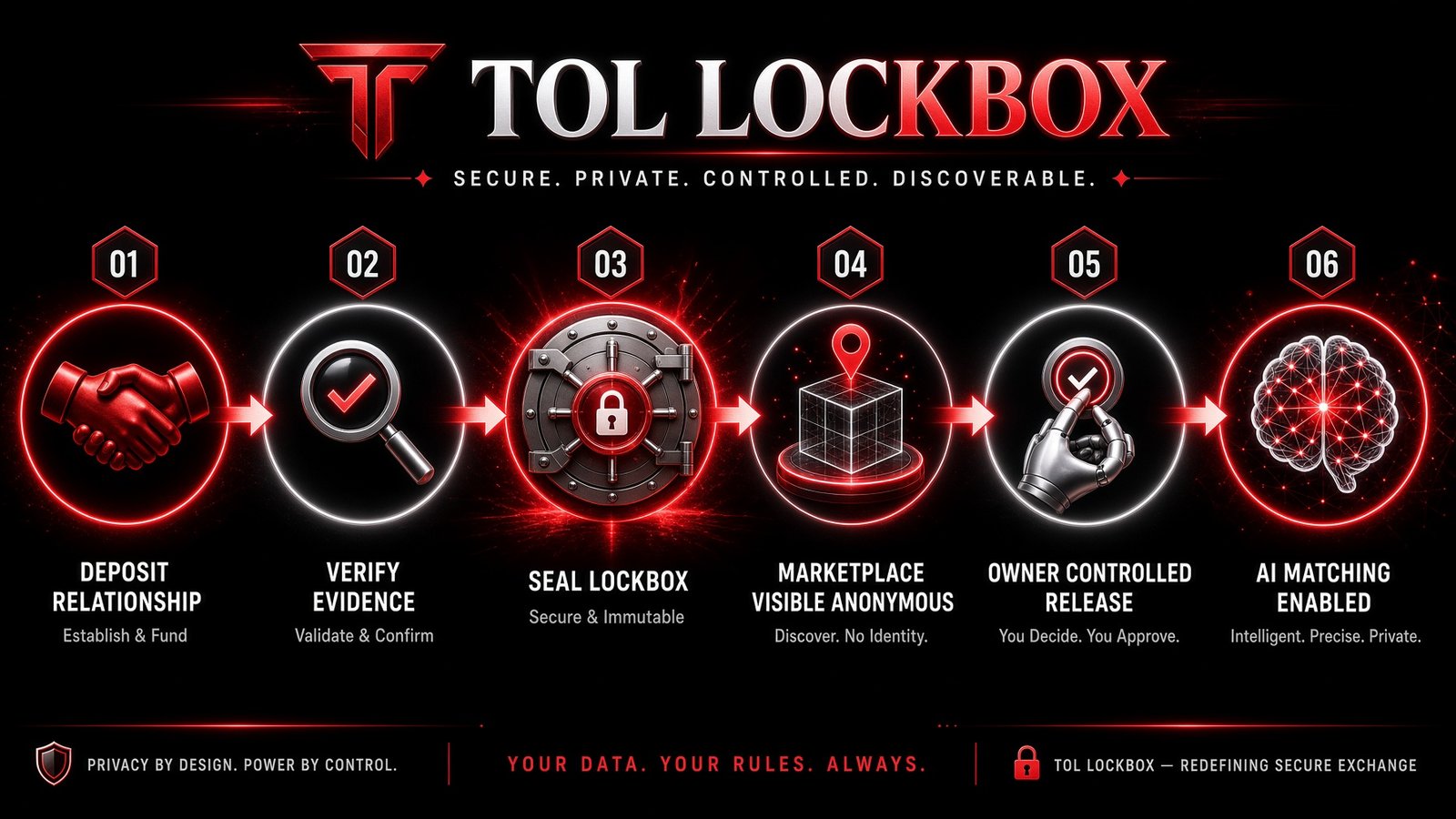
- Deposit relationship. A contributor registers that a relationship exists — the category, the rough capacity, the jurisdiction — without naming the counterparty.
- Verify evidence. Whatever can be checked without exposing the counterparty gets checked: is this a real, active relationship, roughly the size claimed.
- Seal lockbox. The record is timestamped, provenance-stamped, and locked. From this point the deposit is evidence, not just a claim.
- Marketplace visible, anonymous. The sealed record contributes to the aggregate capacity the market can see — the “12 verified providers” a Visible Marketplace card shows — without revealing which twelve.
- Owner-controlled release. Only the contributor decides when, and to whom, the contents unlock — and only after an eligible match exists on the other side.
- AI matching enabled. Once sealed, the relationship becomes something the matching layer can route against, even while its contents stay closed to everyone but its owner.
What the market sees today
A worked example of sealed inventory, broken out by region.
17
Verified acquiring relationships sealed. Illustrative
8
EU
4
LatAm
3
APAC
Plus 2 relationships sealed under a global mandate, not tied to a single region. Illustrative — a worked example, not a live inventory count.
Fair attribution: history, proximity, evidence, time
Never “first person to type a public company name wins.” Attribution is decided on four factors, together.
History
How long the contributor has actually held this relationship, evidenced by the deposit record and whatever supporting history was verifiable at seal time — not a claim made this week.
Proximity
How close the contributor actually sits to the decision-maker on the other side — a direct relationship outweighs a relationship to someone who knows someone.
Evidence
What can actually be verified: prior transactions, documented communication, anything that turns “I know them” into something checkable.
Time
The timestamp on the sealed record itself. Once sealed, a relationship’s priority is fixed — nobody can backdate a claim after seeing that a match exists.
Attribution is a right to participate on the terms it was sealed under. It is never ownership of a relationship, a company, or a person.
The rule that keeps this from becoming a land grab
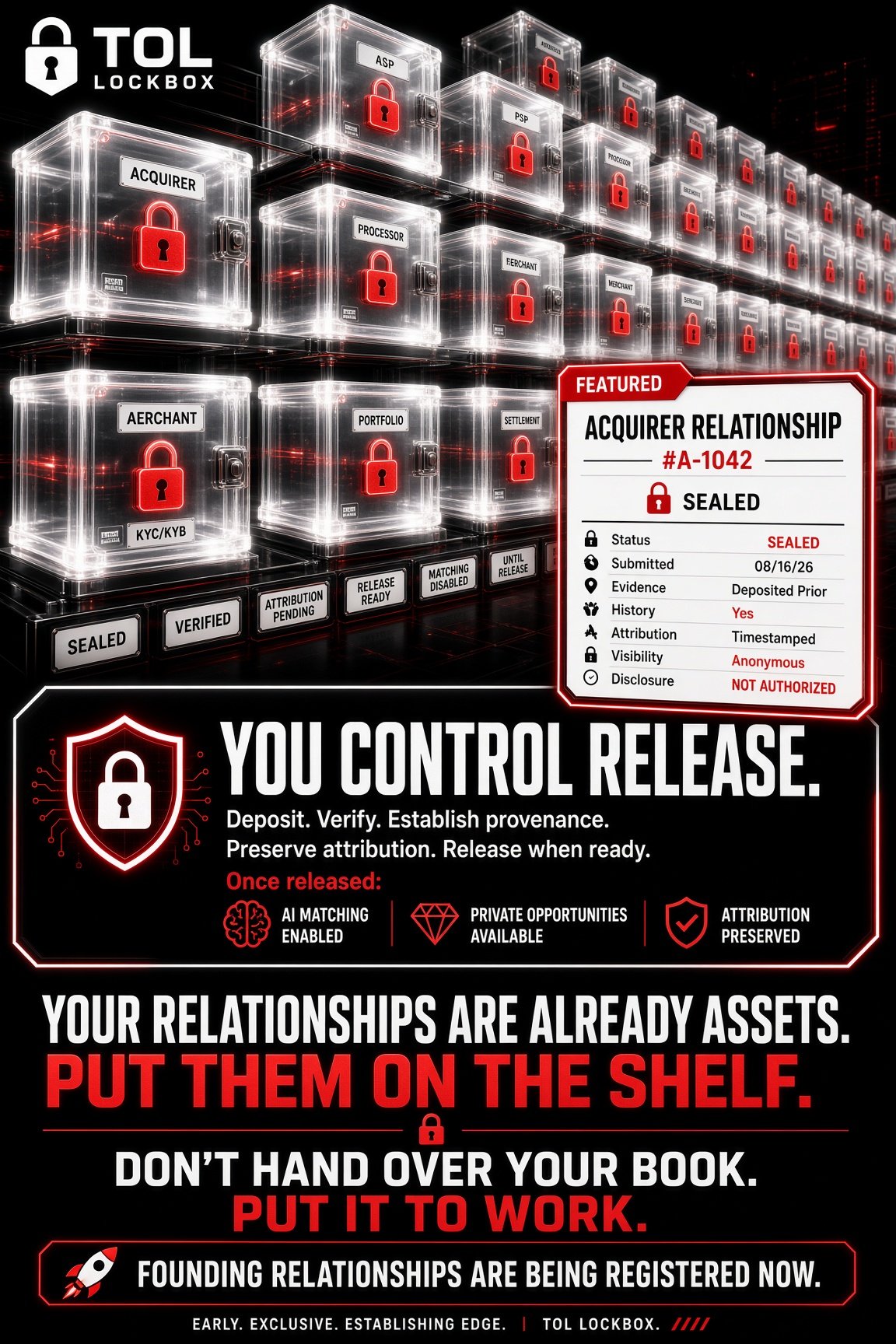
Rewarding the people who built this market already
Every relationship-driven market has a Wild West era, and the people who built real relationships during it are the ones who make the eventual structured market worth anything. Top of the Book is built to reward that history rather than erase it: a contributor who seals a relationship early, before the market has much liquidity, keeps the attribution that record establishes for as long as they hold it.
The goal is not to route around the people who already did the hard work of building trust in this industry. It is to give that work a place to compound instead of resetting to zero every time a new counterparty needs convincing from scratch.
Sealed and attributed is only useful once it can actually be matched against real demand. That is the next layer.