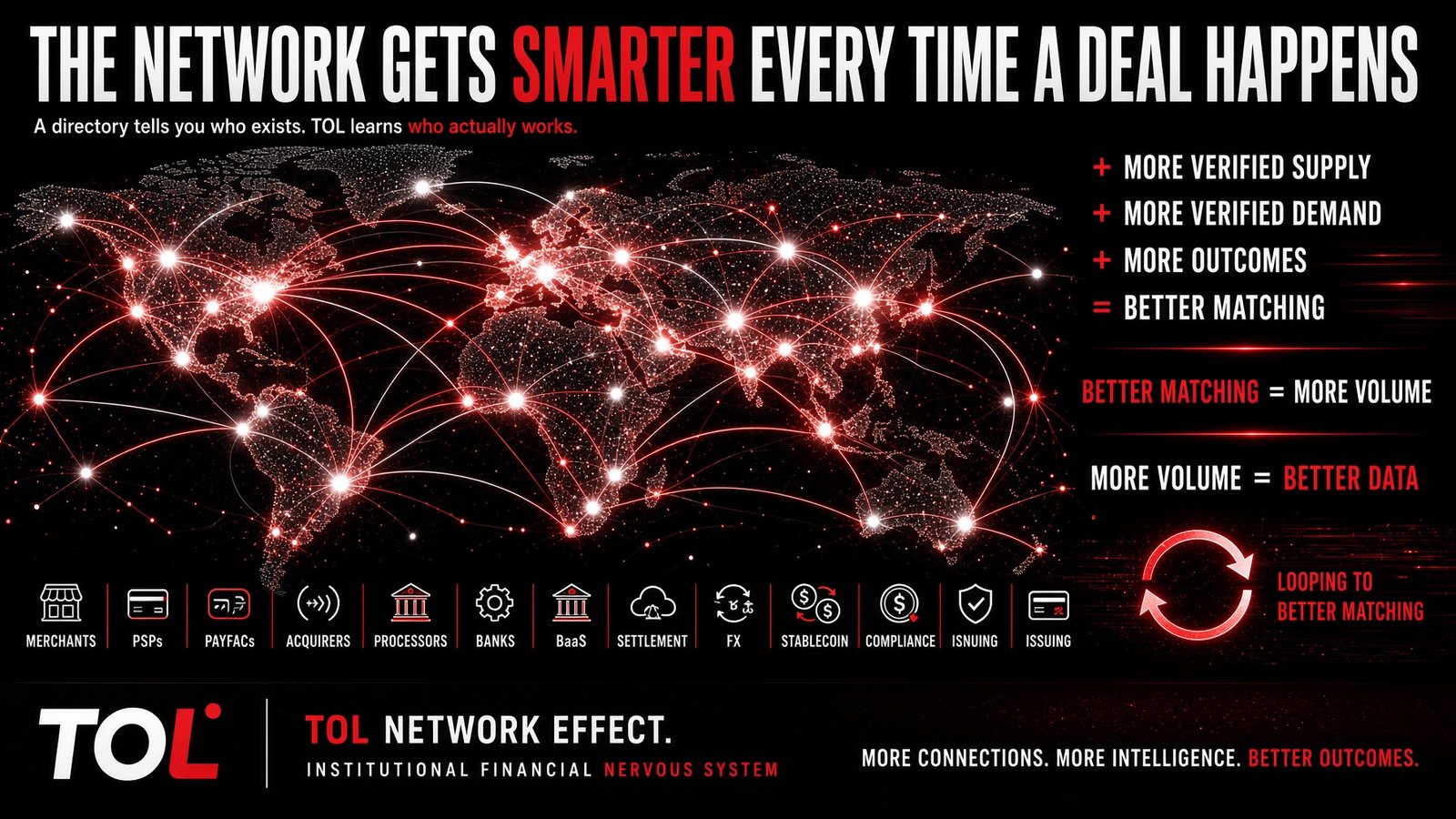
Stop 2 of six
Closed access. Visible market. Private economics.
Top of the Book makes financial relationships visible enough to create a market, private enough to protect their value, and structured enough to actually get deals done. Here is the mechanism, in four layers.
Closed but visible — what that actually means
A directory is open and shallow: anyone can see a name, nobody can tell if it is real. A private deal chat is closed and deep: real information moves, but only inside one relationship, and none of it compounds for anyone else. Top of the Book sits deliberately between the two.
Visible at the market level. A vetted participant can see that capacity exists — that there are, say, twelve verified acquiring providers active in a region, or that a category of merchant has real, qualified demand behind it. That visibility is what makes it a market instead of a rolodex.
Private at the deal level. The same participant cannot see whose relationship that capacity actually is, what the underlying economics are, or who else is circling it. That privacy is what makes the visibility safe to offer in the first place — nobody has to publish their book to prove it exists.
The four-layer model
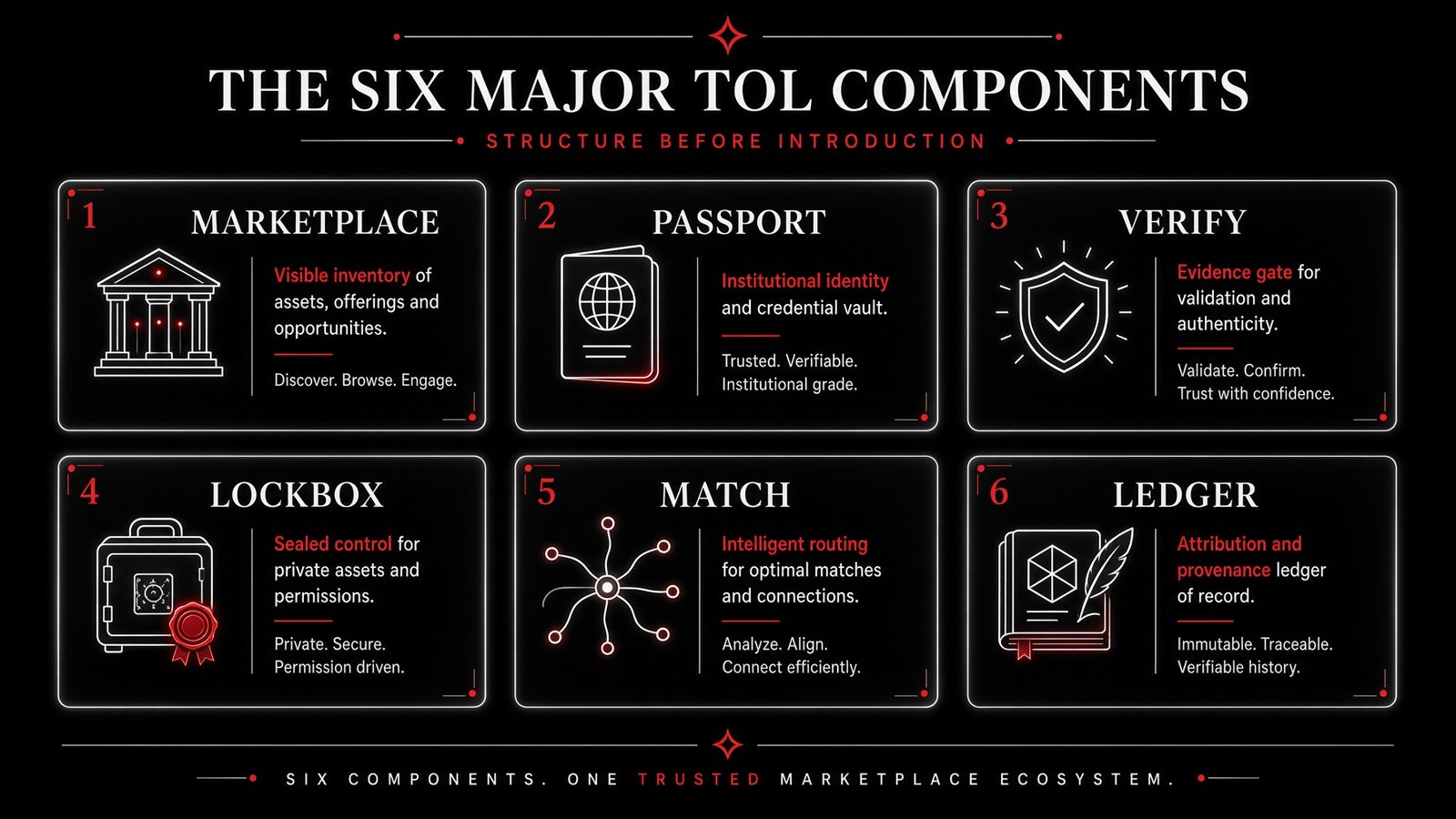
Six working parts — marketplace, passport, verify, lockbox, match, ledger — roll up into four layers. Each layer is a stop later in this tour; this is the map.
Visible Marketplace
The layer a vetted participant actually sees: aggregate capacity and aggregate demand, by region, category, and rough size — never a name, never a book. This is what makes the market legible without making any single relationship public.
Top of the Book Passport
A reusable corporate financial identity for the counterparties transacting through the market — legal entity, jurisdictions, licenses, processing history, risk metrics, all verified once and reused everywhere instead of rebuilt for every provider. Stop 3 is the whole page on this.
Lockbox + Attribution
Where a relationship actually lives once it enters the market: sealed, provenance-stamped, visible to the market as inventory without exposing who holds it or what it contains. Attribution to the person who brought it in is recorded here, and preserved through everything that happens next. Stop 4.
Private Matching + Execution
Eligibility, then ranking, then a private RFQ between two counterparties who never had to advertise themselves to get there. This is the layer that turns visibility into an actual transaction. Stop 5.
What the market actually sees
Two worked examples — a capacity card the market can see, and an opportunity card behind it. Both illustrative.
Capacity visible to the market
EU Acquiring Capacity — 12 verified providers. Illustrative
Opportunity visible to eligible supply
Merchant Portfolio #MP-184 — EU domicile, seeking acquiring capacity. Illustrative
Why closed, not open
An open directory optimizes for reach: the more names on it, the better it looks. Top of the Book optimizes for the opposite — the fewer unverifiable claims that get through the gate, the more a verified capacity card or opportunity card is actually worth to the participant looking at it.
That is the whole trade this tour is arguing for: give up the illusion of an open market where everyone can list anything, in exchange for a smaller, closed market where what you see is real. The next three stops are each one layer of how that gets enforced — starting with the identity layer, the Top of the Book Passport.